*This article was used as the basis for an episode of John Lordan’s Seriously Mysterious podcast.*
EARLY LIFE:
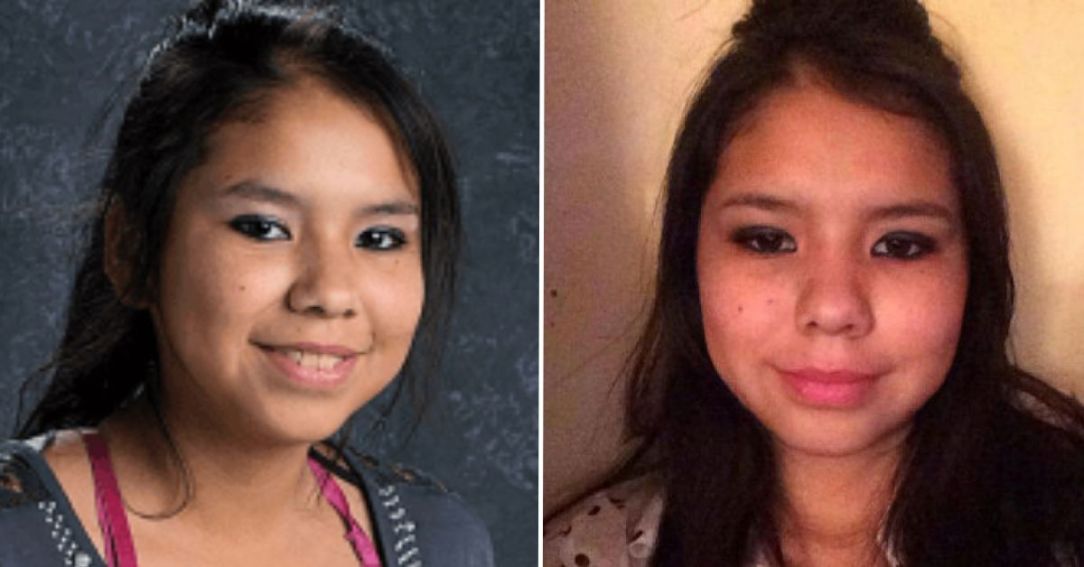
Tina Fontaine was born on January 1, 1999 to Valentina Duck and Eugene Fontaine. Both struggled growing up, with Eugene suffering the ill-effects of Canada’s residential school system. At 12 years old, he left his home in Manitoba’s Sagkeeng First Nation and moved to Winnipeg, where he lived on the street and struggled with drug and alcohol abuse.
Valentina was born and raised in the Bloodvein First Nation, north of Winnipeg. When she was six years old, she was removed from her home by Manitoba Child and Family Services, the start of repeated removals until she was made a permanent ward of the state when she was 10.
Once in the care of CFS, Valentina began to rebel, running away and using drugs and alcohol. She met Eugene when she was 12 years old and he, 23. CFS records shows social workers were aware of the relationship and Eugene’s history of violence.
In spring 1996, Valentina gave birth to the couple’s first child, a boy, who was immediately taken into CFS custody. Tina was born three years later. This time around, the couple was allowed to keep their child, as they’d taken steps to better their lives and break free of their struggles with drugs and alcohol. They’d also been attending parenting classes.
Tina’s little sister, Sarah, was born a year later. It was around this time the pair were removed from their parents’ care, after Valentina and Eugene left them with their grandmother and didn’t return. The children were given back four days later, but no assessment was done to determine if their parents could properly care for them.
The pair were seized again the following year, after their parents were seen leaving a house party intoxicated, with them in tow. They are housed in a hotel before being placed in the foster care system. Eugene and Valentina broke up not long after, and following the completion of parenting courses and addiction treatment, the children were returned to Eugene’s custody.
In 2004, Eugene was diagnosed with cancer, prompting him to request that the children’s great-aunt and uncle, Thelma and Joseph Favel, take them in. Thelma was granted permanent custody soon after, and Tina and Sarah lived at her home in Sagkeeng First Nation for over a decade.
On October 31, 2011, Eugene was beaten to death by two individuals after a three-day alcohol and drug binge. While the men eventually plead guilty to charges of manslaughter, Eugene’s death greatly affected Tina. Thelma attempted to get her counselling through CFS, but it failed to arrange any services for her.
Following Eugene’s death, Tina started acting up in school, missing assignments, smoking marijuana and skipping class. She also got into verbal and physical confrontations, and received medical treatment for self-harm. During this time, Thelma continued to request help from CFS, but her calls for help went unanswered.
Before her father’s death, Tina was your average preteen. She enjoyed school, and was always looking out for those who were bullied. She also went out of her way to take care of the younger children on the reserve.
LEAD UP TO DISAPPEARANCE:
On November 1, 2013, Tina ran away to visit Valentina in Winnipeg. Child welfare workers located her and placed her in a shelter before returning her to Thelma’s care.
Still reeling from her father’s death, Tina paid tribute to him on her 15th birthday by getting a tattoo. The piece, placed between her shoulder blades, featured Eugene’s name and his birth and death dates between a pair of angel wings.
Following her visit to Winnipeg the previous year, Tina begged Thelma to allow her to visit Valentina again. Knowing she had a history of working in the sex trade, Thelma placed a call to Valentina’s case workers to make sure it was safe for Tina, and allowed the visit. After Tina was discovered deceased, CFS claimed to have no record of this interaction occurring.
Things grew worse for Tina when she began to write a victim impact statement in regards to her father’s death. Her worsening behaviour and mental health prompted Thelma to request in April 2014 that her niece be placed in the care of CFS. A worker met with the 15-year-old on May 5, 2014, and a month later Tina was referred to counselling services in Winnipeg and Beausejour. However, transportation issues prevented her from accessing these resources.
Thelma allowed Tina and her sister to visit Valentina at the end of June 2014. This time around, she didn’t check into her lifestyle, meaning she was unaware that since Tina’s last visit, Valentina had lost custody of her children and was back on the streets. On June 30, Thelma’s daughter and son volunteered to drive the pair to Winnipeg, each with some money and a calling card.
While Sarah ended up returning home with Samantha and Brian, Tina stayed. According to Sarah, Tina texted her numerous photos during her time in Winnipeg, which showed her doing drugs and with bruises over her body. The latter were the result of Valentina and her boyfriend beating her.
DISAPPEARANCE:
Tina didn’t return to Sagkeeng First Nation and Thelma placed her in the care of Manitoba Child and Family Services. From July 17-18, 2014, she was placed in an area hotel, but ran away and later told a social worker she was staying at a local group home. According to Valentina, her daughter only stayed with her a few times, the last of which was July 22.
Tina’s aunt, Lana, later told police she’d stayed with her over the August long weekend.
From July 23-29, Tina stayed at the Ndinawe Youth Resource Centre. On July 27, she was reported missing by a shelter employee after missing curfew. While she returned the next afternoon, she missed curfew again on July 30, prompting the shelter to give away her bed. For the second time, she was reported missing to the Winnipeg Police Service.
On August 5, Tina called a CFS worker and was picked up. On August 6, she made a phone call to 911, saying a friend by the name of “Sebastian” – real name Raymond Cormier – had stolen a pickup truck. The dispatcher told her to call a different number and Tina disconnected.
A police report from August 8 places Tina in downtown Winnipeg. At 5:15am that morning, two officers spoke to her during a traffic stop on Isabel Street, an area known for prostitution. They’d first noticed the vehicle she was in – a black pickup truck – while patrolling the Spence neighbourhood. They tried to approach it after seeing it stopped near Ellice Avenue and Furby Street, but the driver sped away.
When they caught up with the vehicle, the driver was taken into custody for driving with a suspended license. Tina was spoken to and initially refused to give them her real name. She eventually revealed her identity and her name was run through the system. While she was still considered missing in the Winnipeg Police Service’s database, the officers claimed the system didn’t flag her.
One of the officers asked where she was staying, to which Tina responded the Quest Inn on Ellice Avenue. After declining a ride to the location, she was let go. Later, the two officers involved in the traffic stop were reassigned while an internal investigation occurred into the interaction.
Five hours later, Tina was found passed out in the parking lot behind the Helen Better Osborne Centre on Ellice Avenue by a University of Winnipeg security guard. Paramedics were called and she was transported to the Health Sciences Centre – Children’s Hospital.
While drowsy, she didn’t appear to have suffered any injuries. However, blood tests showed her blood alcohol content was 0.09, while urine tests showed traces of alcohol, cannabinoids and cocaine in her system. When confronted about this, she admitted to having drunk three beers and taken gabapentin (known on the street as “gabbies”) the previous night. When questioned about being sexually exploited, she refused to answer any questions or undergo a physical exam.
Tina’s CFS worker met her at the hospital and took her to McDonald’s before driving her to the Best Western Charterhouse hotel. During the drive, the young girl confided in the worker that she and her boyfriend, Cody, had been hanging out with a much older man by the name of Sebastian, who’d promised to find her a bicycle. Concerned, the worker told Tina that CFS could buy her a bike if she stayed in their care, but she refused, saying she needed to meet friends at Portage Place.
In an interview with CBC News following Tina’s death, an 18-year-old named Katrina helped fill in the blanks surrounding Tina’s hospitalization. According to Katrina, she’d met Tina between 10:00pm and 11:00pm on August 7 and, fearing her friend was drunk, took her to the Macdonald Youth Services – Youth Resource Centre & Emergency Shelter for food and a place to sleep. However, Tina refused to stay and wouldn’t provide employees with her name.
An hour later, Katrina saw Tina jump into a truck with a group of unknown men. Concerned, she flagged down a passing police cruiser, whose officers stopped the vehicle and set Tina free.
The next time Katrina saw Tina, it was 8:00pm on August 8, after she’d left the Best Western Charterhouse hotel. After informing Katrina of her day, the two hung out until 3:00am the next morning, when a man approached them on Ellice Avenue and offered Tina money to perform a sex act. The young girl accepted and left with the unknown individual, and while Katrina tried to follow the duo, she lost sight of them in the darkness.
Later that day, August 9, Tina was once again reported missing.
According to Sarah, this was around the time she received her final text from Tina, which was directed toward Thelma and Joseph. In it, she’d said, “Tell momma and poppa I love them and miss them, but I’m not ready to go home.”
DEATH:
On August 17, 2014, Tina Fontaine’s body was found wrapped in plastic and a duvet cover in the Red River, near the Alexander Docks. It was discovered while divers were searching for another Indigenous person, Faron Hall, who was seen struggling in the water near The Forks. He, too, would be found deceased.
According to investigators, Tina’s body had been weighed down in the water with rocks, and due to the level of decomposition, it took four hours for them to determine the remains were that of a young female. She was later identified as the missing 15-year-old by the tattoo on her back.
Tina’s cause of death could not be determined, but due to the circumstances was deemed a homicide. There were also signs of sexual assault. A toxicology report showed she had a significant amount of marijuana in her system and that her blood alcohol level was 0.099. However, the toxicologist didn’t believe them to have contributed to her death, and noted the levels may have registered artificially high due to decomposition and the fact the tests were conducted on chest-cavity fluid, as opposed to blood.
Tina was buried on the Sagkeeng First Nation next to her father. On the first anniversary of her death, a memorial was placed on the grave site.
INVESTIGATION:
Investigators went door-to-door in Winnipeg’s West End, as that was the last location they could place Tina. They specifically focused on Ellice Avenue, Langside Street and Furby Street, as well as the area around Portage Place, asking if anyone had noticed anything suspicious.
The duvet Tina was found wrapped in was a point of interest for investigators, who launched an effort to locate its owner. They soon learnt it was only sold at Costco, and that 800 had been purchased in the Winnipeg area. Of those, only 100 people cooperated, while others said they’d since donated or gotten rid of theirs.
On October 1, 2014, Raymond Cormier was arrested after investigators received a tip. At the time, he was already a suspect in Tina’s case and had other outstanding warrants. He tried to evade arrest, but was caught and brought in for interrogation. When asked why he ran, he stated he didn’t want to go to jail.
When questioned about Tina, Cormier claimed to have only known her for a few weeks. He said they’d met around five or six times, and that the last time he saw her was days before her body was found.
He explained that Tina had come to the house he was staying at, crying over Cody returning home to his home to St. Theresa Point. She left after learning Cormier had sold her bicycle for two grams of marijuana. He followed her down Glenwood Crescent, at which point they got into an argument. Cormier claimed that as they were walking, he noticed a man across the street, whom he described as White with long hair – similar to Robert Plant.
According to Cormier, he’d learned of Tina’s death from the news.
Following their interaction with Cormier, investigators launched Project Styx. It ran from June to December 2015, and involved numerous undercover officers who wore recording devices and engaged him in 62 “scenarios” designed to elicit information about Tina’s death. In order to get close to Cormier, they also arranged for him to live in an apartment at 400 Logan Avenue, which was also bugged.
The recordings obtained during this period played a key part in the Crown’s case. A number of them featured Cormier speaking to different individuals about Tina and her death. While he never admitted to killing the 15-year-old, he did make several incriminating statements:
- July 2015 – In an interaction with an unidentified female, he said: “15-year-old girl, fuck. I drew the line and that’s why she got killed. She got killed. I’ll make you a bet. She got killed because we found out. I found out she was 15 years old.”
- August 2015 – While using drugs with a group of unknown individuals, he said: “Don’t overdose here because then your body’s gonna be wrapped up in a fucking carpet and thrown in the river.”
- November 2015 – In one of the last recordings, Cormier is heard talking to himself: “You think you’ll get the murder out of me. Hmm. That’s fuckin’ it, man. Get away from me. Get away from me.”
Project Styx culminated in a sting operation in British Columbia, after which Cormier was arrested and charged with second-degree murder. He pleaded not guilty to the charge.
TRAIL:
Cormier’s trial began on January 29, 2018. The Crown’s case was largely circumstantial, as investigators had been unable to uncover any forensic evidence connecting him to Tina. They argued Cormier killed Tina because he wished to have sex with her, and when he found out she wasn’t 18, he killed her because he didn’t want to be known as a pedophile. This was based on the recordings produced during Project Styx, along with witness testimony that placed Cormier and Tina together in the days leading up to her death.
The jury also heard testimony from witnesses who’d seen Cormier with the same type of duvet found wrapped around Tina’s body. Two police officers with the Winnipeg Police Service testified that Ida Beardy, who’d allowed Cormier to live in a tent in her backyard, had positively identified the duvet as his, as had her daughter.
The defence challenged the Crown’s evidence, saying their case was built on inferences made from the recordings, which, for the most part, were hard to decipher. They argued that the statements made on them could not be verified by just listening to the audio, and pointed out that Cormier never outwardly admitted to killing Tina.
Cormier’s lawyers also brought up the unreliability of witness testimony, and that a cause of death hadn’t be determined, meaning the jury couldn’t say with certainty that Tina had died of an unlawful act. As such, it was argued Cormier be acquitted “on that alone”.
On February 22, 2018, after 13 hours of deliberation, the jury of seven women and four men acquitted Cormier of any involvement in Tina’s death. Less than a month later, on March 13, 2018, prosecutors announced they wouldn’t be appealing the decision.
In an interview with CBC in March 2019, Cormier admitted to giving Tina marijuana, but denied sexually exploiting or killing her.
AFTERMATH:
Tina’s death increased the spotlight on Canada’s missing and murdered Indigenous women. It prompted a renewed call for a national inquiry, led by the Canadian Human Rights Commission. In the direct aftermath of her death, more than 1,000 people took to the streets and dozens camped outside the Manitoba legislature for weeks, demanding the government take a closer look at the cases.
Winnipeg’s mayor called for Canadians to “confront the shame and tragedy” of racism, while Indigenous leaders petitioned for change. This led the province, under the leadership of Premier Brian Pallister, to pledge an end to the marginalization of Indigenous women, and prompted the federal government to launch the National Inquiry Into Missing and Murdered Indigenous Women.
Since Tina’s death, Katrina has begun working with girls she meets on the street, writing down the license plates of the vehicles they get into, in case anything were to happen to them. She’s said she felt a lot of guilt in the months following Tina’s death, but has since managed to move on.
As Tina was being cared for by Child and Family Services, her case was reviewed by Manitoba’s Office of the Children’s Advocate. An internal investigation was launched into how she managed to slip through the cracks, and on June 1, 2015, CFS announced it would no longer be placing children in hotels.
The case has prompted the creation of numerous volunteer groups within Winnipeg. One, known as Drag the Red, regularly drags the Red River for bodies or evidence in open missing persons or homicide cases. Another is the Bear Clan Patrol, which promotes safety and crime prevention in the city’s North End. Speaking about his decision to form the group, organizer James Favel said, “When we first started out, it was in the wake of Tina Fontaine’s murder. Her ultimate demise – the disrespect that was shown to her personhood – was the last straw for me, my family and my community at large.”
Tina’s death led the Assembly of Manitoba Chiefs to form the First Nations Family Advocate Office. There was also the creation of the Strong Hearted Buffalo Women Crisis Stabilization Unit, a semi-secure crisis intervention program for Indigenous women at risk of sexual exploitation.
In March 2018, the Manitoba government announced it would not call for a public inquiry into Tina’s death. This sparked immediate backlash from both Indigenous leaders and the province’s opposition parties.
Federal funding allowed the Ndinawe Youth Resource Center to rename itself “Tina’s Safe Haven” and launch a safe space for youth, which is open 24/7.
In March 2021, Raymond Cormier was arrested in Ottawa, Ontario for allegedly breaking into mail and storage rooms, apartments, and parking garages at four different complexes. It’s unknown how long he’d been residing in the city, but at the time of his arrest he was staying at a local homeless shelter.
CASE CONTACT INFORMATION:
Those with information regarding the death of Tina Fontaine are asked to contact the Winnipeg Police Service at (204) 986-6508 or Crime Stoppers at (204) 786-8477.
Image Credit: Wikipedia/Toronto Star

 Stories of the Unsolved