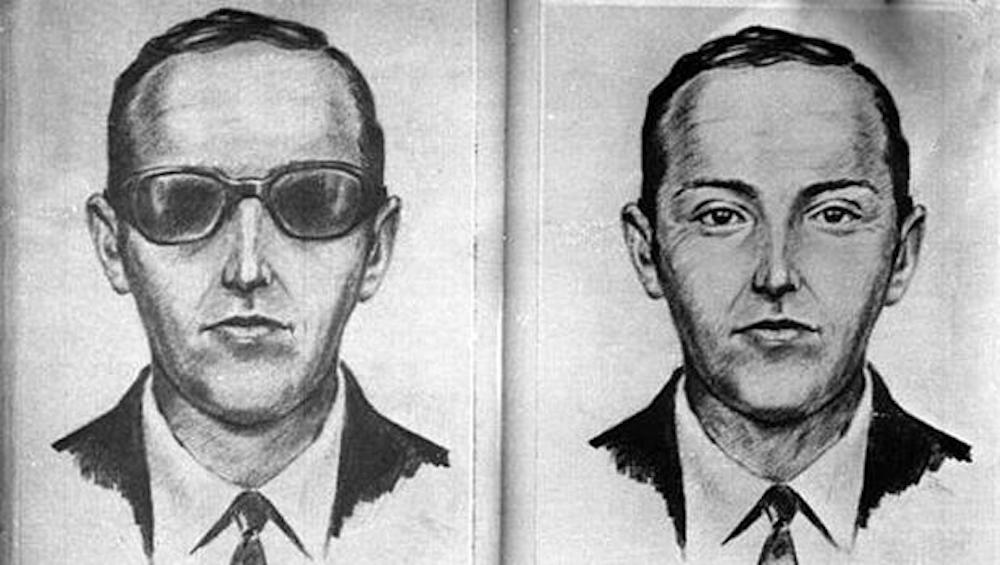
HIJACKING:
On the afternoon of November 24, 1971, a man identifying himself as “Dan Cooper” entered the airport in Portland, Oregon. He purchased a $20 airline ticket for the 2:45 PM flight to Seattle, Washington. The aircraft was a Boeing 727, designated Flight 305.
There were no mandatory security checks on domestic flights back in the early 1970s, so Cooper was able to board the flight without having his bags checked. Once the aircraft had boarded (36 passengers and six crew members), he took his seat at the back. He then ordered a bourbon and soda on the rocks from the flight attendant, at which point the flight took off.
At around 2:58 PM, Cooper handed the flight attendant an envelope. Thinking he was merely flirting with her, she stuffed it away. However, upon his insistence, she opened it, revealing a note that read: “Miss, I have a bomb and I would like you to sit by me.”
Shocked by the note, she approached Cooper to clarify what she’d read. To prove the threat, he showed her the inside of his briefcase, which had red sticks and wires. He then threatened to blow up the Boeing 727 if his demands weren’t met. That’s when he told her to call her colleagues in the cockpit and inform them about the bomb.
Not long after being notified, the captain relayed the information to the control tower in Seattle, which notified the FBI and Northwest Orient about the hijacking. Notes were then handed to him, listing out Cooper’s demands; he wanted $200,000, to be placed in a knapsack, as well as four parachutes, two main back ones and two in the front for safety. Upon landing in Seattle, the aircraft was to taxi to a remote part of the runway, where a fuel truck would be waiting.
Northwest Orient agreed to the demands, and FBI agents notified Seafirst Bank, which provided $20 bills with pre-recorded serial numbers.
Throughout the flight, Cooper remained calm, drinking his bourbon and smoking nearly half a carton of cigarettes. Upon landing in Seattle, the passengers were released, as were two flight attendants. The rest of the crew were held captive as the aircraft refuelled, and the money and parachutes were given to Cooper. Once refuelling was complete, the airliner took off once again.
Upon take off, Cooper demanded the Boeing 727 fly at no more than 10,000 feet, with its landing gears out. Its speed was set at 200 MPH and Cooper insisted they fly to Mexico City. However, the aircraft wasn’t carrying enough fuel to make the long flight, so the pilot gave the option to fly to either Reno, Nevada, or Phoenix, Arizona.
Cooper chose Reno.
Once the destination was decided upon, the pilot, who chose the route, set the flightpath to Victor 23. Along the way, the aircraft was tailed by two US Air Force jets. Sometime during the flight, Cooper told the remaining flight attendant to join her colleagues in the cockpit. While she was leaving, she noticed him tie something around his waist, which is believed to be the bag of money. He removed his tie and left behind two of the parachutes.
At 8:10 PM, Cooper jumped from the rear door. It took 35 minutes to make the infamous jump.
INVESTIGATION:
The FBI immediately launched an investigation into the hijacking, which they dubbed “NORJACK”, for Northwest Hijack. However, it was happening at a time when aircraft hijackings were commonplace – by the mid-1970s, at least 150 had occurred in the United States alone.
The immediate search consisted of approximately 1,000 US military troops, who searched the suspected area on foot and by helicopter. The case quickly caught media attention, where a mistake from a wire service led to the suspect being called “D.B. Cooper”. This despite the name having no relevance to the case.
The FBI received numerous tips from across the US and spent the early parts of the investigation interviewing and ID’ing all relevant witnesses. While this was going on, various newspapers were receiving letters about the case, from those either claiming to be the infamous hijacker, eulogizing him or claiming to be his relatives.
From evidence collected, the FBI was able to come to the conclusion that Cooper was familiar with the Pacific Northwest. Agents also surmised that he most likely had a military background, a belief that would later be backtracked. He most likely acted alone, since the pilot chose the flightpath, ruling out the possibility of an accomplice. DNA was also collected from the tie Cooper had left behind.
As the years went by, the FBI started hitting many dead ends. As a result, the bureau changed its charge against Cooper from air piracy, which had a five-year limitation, to a violation of the Hobbs Act, which was designed to prevent extortion. Unlike air piracy, it has no limitations, meaning that, if Cooper were to be found today, he could still be charged for the crime.
The big break in the case came in February 1980, when a young boy discovered a rotting package containing $5,800 in bills on a sandbar near Vancouver, Washington. They shared the same serial numbers as those provided to Cooper, and the FBI theorized they fell into the Washougal River and drifted until they became lodged in the riverbed.
Upon the discovery of the bills, a search was launched in the surrounding area, but no other evidence was found. The FBI used the latest forensic technology to examine the numerous items of evidence collected. However, agents were never able to gain much information from what they have in their collection.
PERSONS OF INTEREST:
Over the years, the FBI considered over 1,000 suspects, with 800 being interviewed within the first five years. At the time the official investigation was closed, all but 24 had been eliminated.
1) The most promising person of interest was Richard Floyd McCoy, who was arrested for hijacking an aircraft in April 1972. For the majority of the case, he was the FBI’s primary suspect, given how similar both his and Cooper’s hijackings were. However, he was eventually ruled out because he didn’t match the description given by the flight attendants who interacted with Cooper.
McCoy was killed during a gunfight with FBI agents after escaping from prison.
2) Duane Weber was one of the many men to confess to being Cooper on his deathbed. According to his wife, Jo, he frequently had nightmares about leaving fingerprints on an aircraft and had a knee injury he claimed to have received from jumping out of an airliner. He also had an old Northwest airline ticket and had previously taken Jo to the area where the $5,800 would later be found.
Despite all this, the FBI doesn’t believe him to be Cooper.
3) Kenneth Christiansen was brought to the attention of the FBI after his brother saw an episode of Unsolved Mysteries that covered the case. Not only had he been a flight purser for Northwest, but he’d purchased a house right after the hijacking. He also had a love for bourbon.
When shown his picture, a flight attendant who’d been on the aircraft during the hijacking said Christiansen looked the most like Cooper out of all the suspects she’d been shown, even though the FBI claimed he didn’t match the description. However, she couldn’t confirm it was him.
The FBI ruled him out because of his history of being a paratrooper – they believed Cooper hadn’t been a skilled jumper.
4) In 2018, Robert Rackstraw was introduced as a suspect by former FBI agents and filmmaker Thomas Colbert. Rackstraw had previously been a person of interest, but was eliminated in 1979, despite being the most viable suspect to many on the case. He was a Vietnam War veteran, having been a Special Forces soldier, explosives expert and pilot with 22 different aliases.
Those who see Rackstraw as a suspect claim the proof is hidden in a series of letters allegedly written by Cooper in the months following the hijacking. It’s believed there was a confession written in code in one of them.
5) Las Vegas-based magazine writer Byron Brown believes Jack Coffelt was Cooper. A purported government informant and conman from Missouri, he was one of the FBI’s top 20 suspects. Brown claims his father accompanied Coffelt to Oregon in 1974 for the $200,000 Cooper stole.
6) Lynn Doyle Cooper is believed by his family to have been Cooper. A war veteran who was also a logger and outdoorsman, he was familiar with the area where Cooper jumped and suddenly disappeared from his family’s life shortly after the hijacking. Given their suspicions, his family passed over items to the FBI, to help assist in the investigation. However, his DNA didn’t match the profile taken from the tie left on the Boeing 727.
THEORIES:
1) Online sleuths believe the hijacking to have been an inside job, with Boeing orchestrating the whole thing. However, the FBI hasn’t given any credence to this theory, and there’s no evidence pointing in this direction.
2) The theory held by many in the FBI is that Cooper didn’t survive the fall from the aircraft. While it had been initially believed he was a paratrooper, the idea was later thrown out because of the amateur mistakes made during the hijacking.
Not only had Cooper jumped with a parachute that had been sewn shut, the one that was operable was military issue and, thus, not steerable. As well, an experienced skydiver wouldn’t have jumped while it was dark and storming into a wooded area shrouded with cloud cover.
However, neither a body nor a parachute have been found.
3) Another theory revolves around the idea that Cooper was an experienced skydiver. While the issues noted above hint that he wasn’t, some of his actions point in the direction he was skilled. He turned down instructions when they were offered, was aware the military chute could better withstand the exit speed of the jump and donned the parachute like he knew what he was doing.
This would also explain why Cooper has never been found.
AFTERMATH:
To this day, the hijacking of Flight 305 remains the only one to be unsolved in the US, and it’s seen by many to be the greatest unsolved crime in the history of the FBI. Due to its infamy, it’s inspired numerous songs, movies, television shows and books.
In 2016, the investigation was officially called off, with the FBI stating the need to allocate resources to more urgent cases. All evidence collected has been preserved for historical purposes at the bureau’s headquarters in Washington, DC.
CASE CONTACT INFORMATION:
While the investigation is no longer active, the FBI has asked that any physical evidence relating to the case be reported to the finder’s local FBI field office.
Image Credit: The Telegraph




 Stories of the Unsolved